
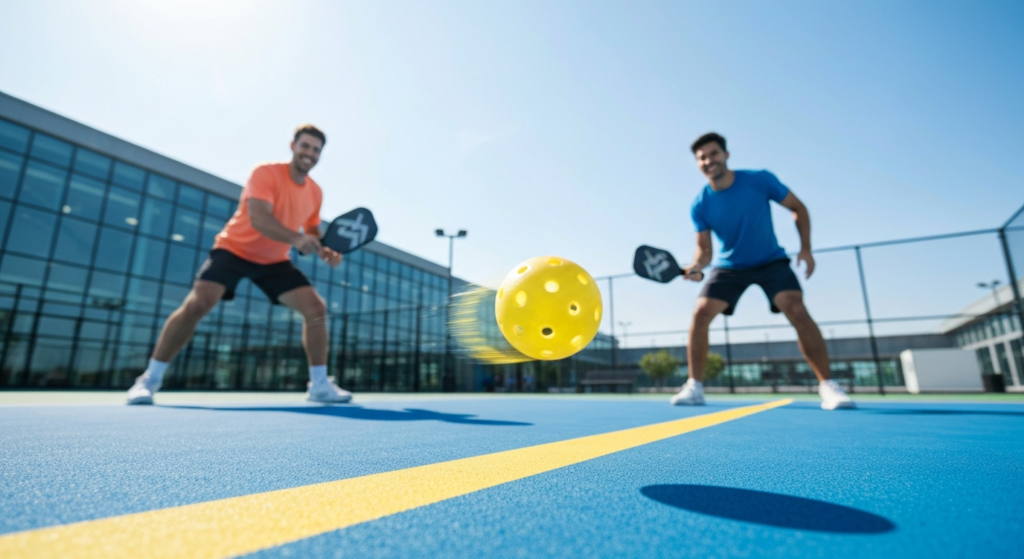
The Joy of a Great Spin Serve
I remember the first time I stepped onto a pickleball court. I thought my tennis background would make everything easy. I walked up to the baseline, hit a flat, hard serve, and watched my opponent return it with ease. Then it was his turn. He swung his paddle in a weird, upward motion, and the ball came toward me looking like it was floating. When it hit the ground, it zipped to the left so fast I almost tripped over my own feet. I was hooked. I spent the next three months obsessed with figuring out how to make that ball move. Learning pickleball serve spin tips changed how I play the game and how much fun I have on the court.
Spin is not just a trick. It is a tool that forces your opponent into uncomfortable positions. When you put spin on the ball, you take control of the point before it even starts. It makes the return harder, which often leads to a weak shot that you can put away. I have found that a good spin serve is more about finesse and physics than raw power. Once you master the feeling of the ball brushing against your paddle, you will see your win rate start to climb. Let’s talk about how you can start adding this to your game.
Mastering the Grip for Better Spin
If you want to start using pickleball serve spin tips, you have to look at your hand first. Most beginners hold the paddle like they are shaking hands with it, which is known as the Continental grip. I use this grip for almost everything. It allows the wrist to stay loose and flexible. If your grip is too tight or your hand is in a rigid position, you cannot snap the paddle through the ball to create that necessary friction.
I like to tell people to hold the paddle with a pressure of about four out of ten. You want it secure, but you want your wrist to feel like a hinge. When I started, I held the paddle way too tight. My serves were flat and boring. When I relaxed my hand, I could finally feel the ball “grabbing” the paddle face. This “grab” is what creates rotation. Without a loose grip, you are just hitting the ball; with a loose grip, you are brushing it.
The Secret of Topspin
Topspin is the bread and butter of a solid game. It causes the ball to dive down toward the court and then jump forward and upward after it bounces. This is great because it allows you to hit the ball harder while still keeping it inside the lines. I use topspin when I want to push my opponent deep into the baseline. It is hard for them to get a good swing when the ball is jumping up at their chest.
To create topspin, you need a low-to-high swing path. I start my paddle down by my knee and swing up toward my opposite shoulder. Think about the paddle face as a brush. You aren’t hitting the back of the ball; you are brushing the back of it from bottom to top. When I first practiced this, I would try to imagine I was trying to comb the “hair” on the ball upward. The faster your paddle moves during that brushing motion, the more the ball will rotate. It takes practice to get the timing right, but once you do, your serves will look like they are going out of bounds only to dive in at the last second.
Adding Sidespin to Frustrate Opponents
Sidespin is where the real mischief happens. This is the serve that made me trip when I was a beginner. Instead of the ball jumping forward, it curves in the air and kicks to the side after the bounce. I love using this against players who have a weak backhand. If I can make the ball curve away from them, they have to reach and stretch, which usually results in a bad return.
For sidespin, your swing path moves across your body. If you are right-handed and want the ball to curve to the left, you brush across the side of the ball from right to left. I found that a slight tilt of the paddle face helps a lot here. One of the best pickleball serve spin tips I ever received was to focus on the “equator” of the ball. For topspin, you go over the equator. For sidespin, you go around it. I spent hours at a local park just hitting side-swipe serves into a fence to see how much curve I could get. It is a blast once you see the ball start to move like a slider in baseball.
The Importance of the Toss
People often forget about the hand that isn’t holding the paddle. Your toss is the foundation of a consistent spin serve. In the current rules of the sport, you can choose a high drop or a toss, but you have to make sure you follow the regulations regarding the height and the upward arc of the swing. I personally prefer a very consistent, low toss. If the ball is moving too much before you hit it, timing the spin becomes very difficult.
I practiced my toss in my kitchen while waiting for water to boil. I would just drop the ball or toss it slightly and try to make it land in the same spot every time. If your toss is consistent, your brain can focus entirely on the paddle path. If your toss is all over the place, you are busy trying to adjust your feet and your swing, which ruins your ability to generate spin. Keep it simple and keep it repeatable.
Pickleball Serve Spin Tips for Daily Practice
You cannot master spin just by playing matches. When you are in a game, you are too focused on winning the point to really work on your technique. I suggest taking a bucket of balls to an empty court at least once a week. Here is a routine that helped me improve quickly:
- The Wall Brush: Stand near a wall and just practice the upward brushing motion without even hitting a ball. Feel the wrist snap.
- The Target Game: Place a towel in the back corner of the service box. Try to hit serves that curve or jump toward that towel.
- Slow Motion Swings: Hit ten serves at half speed. Focus entirely on the contact between the paddle and the ball. I found that I learned more from slow serves than I did from trying to smash the ball.
- The Sideways Challenge: Try to hit a serve that bounces in the box and then exits the side of the court before it reaches the baseline. This really teaches you how to maximize sidespin.
I spent many mornings doing these drills. At first, I felt a bit silly hitting balls by myself, but the results were worth it. My friends started asking me how I was getting so much action on my serves. That is the best feeling in the game.
Choosing Gear That Supports Spin
While technique is the most important factor, the paddle you use does matter. Some paddles have a very smooth surface, which makes it hard to generate friction. Others have a gritty texture that helps the ball stay on the face longer. When I was looking for a new paddle, I looked for ones with a carbon fiber face. Carbon fiber tends to have a natural grit that is perfect for spin.
You don’t have to spend a fortune, but you should look for a paddle that feels “sticky” when you run your thumb across it. Many brands now use a “raw carbon” finish. I switched to one of these about a year ago, and I noticed an immediate difference in how much the ball would dip on my topspin serves. Also, keep your paddle clean! If the face is covered in dust or dirt, it loses its grip. I wipe my paddle down after every session to keep that texture fresh and ready for the next game.
The Role of Swing Speed
There is a common myth that you need to swing as hard as possible to get spin. In my experience, that is not true. Spin comes from the speed of the “brush,” not the force of the “hit.” If you swing too hard, you might just flatten the ball out and lose the rotation. I focus on a fast “snap” at the point of contact. It is a quick, whippy motion.
Think of it like flicking a towel. You don’t need your whole arm to move slowly; you need the end of the towel to move fast. My best spin serves come when my arm is relaxed and my forearm and wrist do the quick work at the bottom of the swing. This allows me to keep the ball deep without it flying long. It is a balance between control and speed. I always prioritize a clean brush over a powerful strike.
Staying Within the Rules
It is vital to remember that the sport has rules about how you can serve. You must hit the ball with an upward arc, and the contact point must be below your waist. Also, the highest point of the paddle head must be below your wrist at contact. When I started adding spin, I sometimes got too fancy and my paddle head would drift up too high. I had to record myself on my phone to make sure I was staying legal.
Using pickleball serve spin tips is only helpful if your serve counts. Practice your spin within these boundaries. You can still get an incredible amount of topspin and sidespin while keeping your paddle head low. In fact, starting the paddle low and swinging up naturally keeps you within the rules while maximizing the rotation you can put on the ball.
Mental Strategy for Using Spin
Knowing how to hit a spin serve is one thing; knowing when to use it is another. I don’t use my heaviest spin on every single serve. If I do, my opponent will get used to it. I like to mix things up. I might hit two deep topspin serves, and then suddenly throw in a sidespin serve that curves toward the centerline. This keeps them guessing and prevents them from getting into a rhythm.
I also pay attention to the wind. If the wind is blowing from left to right, I use a sidespin that moves in the same direction. The wind carries the ball even further, making it almost impossible to return cleanly. Using the elements and your variety of serves makes you a much more dangerous player. I always tell my students to think of the serve as the first move in a chess match. You want to set yourself up for a win several shots down the line.
Common Mistakes to Avoid
One of the biggest mistakes I see people make is trying to do too much at once. They try to hit the ball hard, with spin, and perfectly in the corner. Usually, they end up hitting it into the net. When you are starting out, focus only on the rotation. Don’t worry about the speed. Once you can consistently make the ball jump, then you can start adding more power.
Another mistake is stopping the swing early. I used to poke at the ball and stop my paddle right after contact. This kills the spin. You have to follow through. My paddle usually ends up near my opposite ear after a good topspin serve. A full follow-through ensures that you have transferred all that energy into the rotation of the ball. Let the paddle do the work and finish your motion every time.
Closing Thoughts on Improving Your Game
Learning to add spin to your serve is a journey. It won’t happen in one day, but the process is incredibly rewarding. I still get a little thrill every time I see a ball kick sideways and catch my opponent off guard. It adds a layer of depth to the game that makes every match more interesting. Focus on your grip, your swing path, and your follow-through. Stay relaxed and have fun with the process of learning. If you use these pickleball serve spin tips and stay consistent with your practice, you will be amazed at how much your serve improves. The game is all about growth, and mastering spin is one of the best ways to take your skills to the next level. See you on the court!